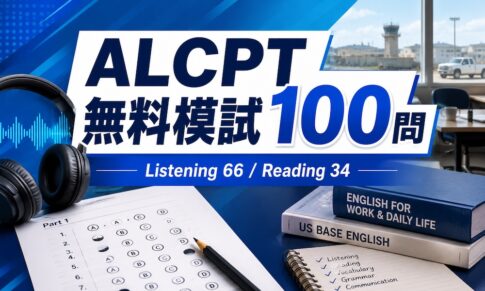
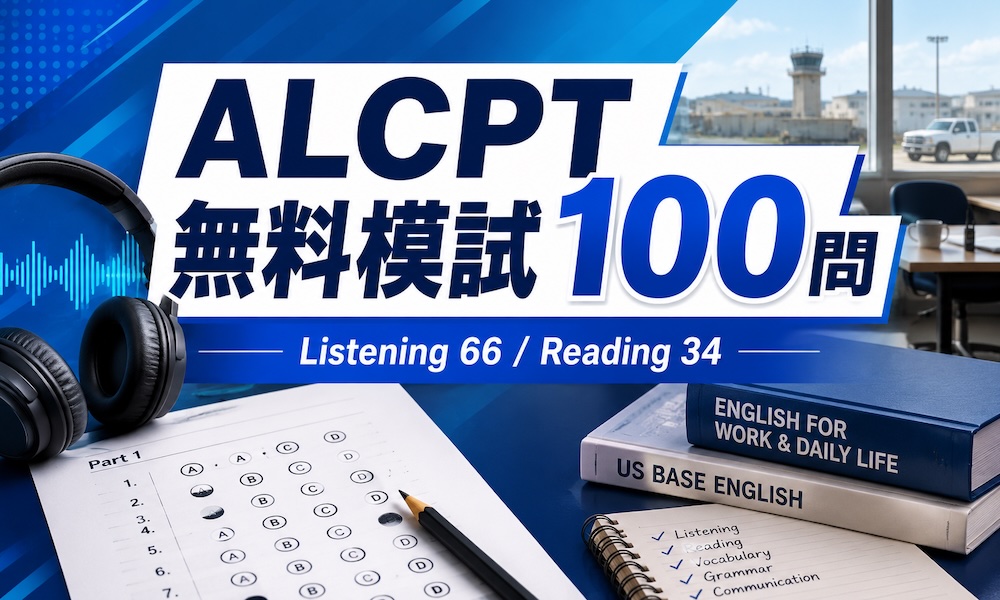
ALCPTの直前対策として使える、リスニング66問・リーディング34問、合計100問のオリジナル模擬問題です。
ALCPTでは、難しい文法知識だけでなく、短い英文を聞いて意味を素早く判断する力、基地・職場・交通・天候・日常生活に関する基本語彙を理解する力が重要です。このページでは、ALCPTで出やすい語彙・場面・文法をもとに、練習用の100問を用意しました。
注意:この模試は公式問題・過去問ではありません。ALCPT対策用に作成した、基地英語.comオリジナルの練習問題です。
ALCPT無料模試100問の使い方
- まずリスニング音声を再生してください。
- Questions 1–66 は、音声を聞いて A〜D から最もよい答えを選びます。
- Questions 67–100 は、英文を読んで A〜D から最もよい答えを選びます。
- 紙やメモアプリに、自分の答えを記録してください。
- 最後に正解一覧で自己採点してください。
Listening Audio: Questions 1–66
下の音声を再生して、Questions 1–66に答えてください。音声では選択肢は読み上げられません。選択肢はこのページ上で確認してください。
Part I: Listening Questions 1–66
Directions: For items 1–56, you will hear a short statement or question. Select the best answer from the four options. For items 57–66, you will hear a short dialogue followed by a question.
-
(A) It is very hot.(B) It is freezing.(C) It is extremely dry.(D) It is very windy.
-
(A) To a hospital.(B) To a library.(C) To a pharmacy.(D) To a bank.
-
(A) He’s a teacher.(B) He’s a mechanic.(C) He’s a doctor.(D) He’s a pilot.
-
(A) It was on the board.(B) It was on the desk.(C) Out of sight.(D) It was in the box.
-
(A) Once a week.(B) Every day.(C) Once a month.(D) Every year.
-
(A) He wants to buy it.(B) He wants to sell it.(C) He wants to fix it.(D) He wants to clean it.
-
(A) $14.20(B) $14.00(C) $13.80(D) $14.50
-
(A) He will forbid him.(B) He will permit him.(C) He will help him.(D) He will accompany him.
-
(A) By air.(B) By ship.(C) By train.(D) By bus.
-
(A) They look different.(B) They look large.(C) They look alike.(D) They look old.
-
(A) Every morning.(B) Every afternoon.(C) Every evening.(D) Every night.
-
(A) In the middle.(B) Near the gate.(C) At the far end.(D) Behind the barracks.
-
(A) All of the students.(B) Just a few students.(C) Only the teacher.(D) None of the students.
-
(A) It became very hot.(B) It turns to ice.(C) It flows faster.(D) It disappears.
-
(A) It was very large.(B) It was very old.(C) It was extremely small.(D) It was very slow.
-
(A) How old it is.(B) How tall it is.(C) Where it is.(D) How much it costs.
-
(A) He was given some food.(B) He was given wrong information.(C) He was given some money.(D) He was given a map.
-
(A) By bus.(B) In a private car.(C) By hired vehicle.(D) On foot.
-
(A) He paid his bill and left.(B) He arrived at the hotel.(C) He looked for a room.(D) He stayed for lunch.
-
(A) He wrote the books.(B) He sells the books.(C) He reads the books.(D) He owns the bookstore.
-
(A) Change his job.(B) Continue working hard.(C) Finish his work early.(D) Ask for help.
-
(A) The moisture in the air.(B) The temperature.(C) The wind speed.(D) The air pressure.
-
(A) He’ll make them work together.(B) He will break them.(C) He’ll turn them off.(D) He’ll look at them.
-
(A) It was for a long time.(B) It was to another city.(C) It was free of charge.(D) It was to a local number.
-
(A) The lights went out.(B) The bill was too high.(C) It rained very hard.(D) The machines were fixed.
-
(A) Things that catch fire easily.(B) Heavy items.(C) Sharp tools.(D) Glass bottles.
-
(A) It was badly smashed.(B) It was cut.(C) It was burned.(D) It was broken.
-
(A) The wire is not covered.(B) The wire is too short.(C) The wire is broken.(D) It’s the wrong size.
-
(A) It is very small.(B) It is extremely large.(C) It is medium-sized.(D) It is old.
-
(A) Rain and lightning.(B) A strong wind.(C) A light snow.(D) A very hot day.
-
(A) Up and down.(B) Side to side.(C) In a circle.(D) Diagonally.
-
(A) Take part in games.(B) Watch sports on TV.(C) Read about sports.(D) Buy equipment.
-
(A) He did not use his time well.(B) He studied very hard.(C) He finished school early.(D) He was a brilliant student.
-
(A) He removed it.(B) He put it on.(C) He bought it.(D) He cleaned it.
-
(A) The characteristics of water.(B) Who owns the water.(C) How much it costs.(D) Where it is located.
-
(A) It is a metal.(B) It is a food.(C) It is a liquid.(D) It is a gas.
-
(A) August.(B) June.(C) September.(D) May.
-
(A) Clear.(B) Cloudy.(C) Sunny.(D) Blue.
-
(A) They are the right size.(B) They are too big.(C) They are too small.(D) They are the wrong color.
-
(A) The blue one.(B) The gray one.(C) They cost the same.(D) Neither one.
-
(A) Your first name.(B) Your last name.(C) Your father’s name.(D) Your middle name.
-
(A) In a large house.(B) In a small house.(C) Near the park.(D) In an old house.
-
(A) Correct forms.(B) New forms.(C) Old forms.(D) Large forms.
-
(A) What do you do for fun?(B) What is your job?(C) Where do you live?(D) What is your rank?
-
(A) A very good one.(B) A very bad one.(C) A common one.(D) A cold one.
-
(A) All of the students.(B) Only the teacher.(C) A few students.(D) The best students.
-
(A) How wide it is.(B) How long it is.(C) How high it is.(D) How old it is.
-
(A) It’s in good condition.(B) It’s the wrong color.(C) It’s a new model.(D) It’s very fast.
-
(A) After the sun went down.(B) At noon.(C) In the morning.(D) Before breakfast.
-
(A) The time he woke up.(B) The time he went to bed.(C) The time of the test.(D) The time of lunch.
-
(A) Pay close attention.(B) Forget her lessons.(C) Change her lessons.(D) Share her lessons.
-
(A) The power was stopped.(B) The lights came on.(C) The storm got worse.(D) The bill was paid.
-
(A) When he was hit.(B) When he ran fast.(C) When he fell down.(D) When the game ended.
-
(A) There is not enough food.(B) There is plenty of food.(C) The food is bad.(D) The food is cheap.
-
(A) Warm air is thinner.(B) Warm air is heavier.(C) Warm air is wetter.(D) Warm air is faster.
-
(A) To his friend’s house.(B) To the shoe store.(C) To the park.(D) To school.
-
(A) It’s her favorite sport.(B) She doesn’t like it.(C) She thinks it’s boring.(D) She only plays on Saturdays.
-
(A) A map.(B) A textbook.(C) A dictionary.(D) A telephone.
-
(A) He’s sure it stops.(B) He thinks it stops.(C) He knows it doesn’t.(D) He wants to go there.
-
(A) He is not taking sides.(B) He thinks his sister is right.(C) He thinks the woman is right.(D) He’s angry.
-
(A) If the friend has a husband.(B) Where the friend lives.(C) How old the friend is.(D) Her job.
-
(A) To say he’s sorry.(B) To leave.(C) To pay her.(D) To help her.
-
(A) On the radio or TV.(B) In a book.(C) From a friend.(D) In a letter.
-
(A) Tubes.(B) Trucks.(C) Trains.(D) Boats.
-
(A) It’s very large.(B) It’s very small.(C) It’s very old.(D) It’s very new.
-
(A) It became thin and old.(B) It was stolen.(C) It was too big.(D) She lost it.
解答解説PDFを準備中です
この模試の詳しい解説、重要単語、スコア別の復習ポイントをPDFで配布予定です。
ALCPT対策アプリや追加の無料模試を公開したときにも、このページでお知らせします。
Part II: Reading Questions 67–100
Directions: Choose the best word or phrase to complete the sentence.
-
He _____ to the market every morning.
(A) go(B) goes(C) going(D) gone -
_____ book on the table is mine.
(A) A(B) An(C) The(D) (No article) -
By the time we arrive, she _____ dinner.
(A) will finish(B) will have finished(C) finishes(D) had finished -
The wind cuts like a knife. This means it is:
(A) very dusty(B) freezing cold(C) very sunny(D) a light breeze -
Henry made a _____ decision.
(A) foolish(B) wise(C) embarrassing(D) confusing -
The passenger ship is _____.
(A) small(B) gigantic(C) tiny(D) slow -
Which of the following is a correctly punctuated question?
(A) What time it is.(B) What time is it?(C) What time is it.(D) What time is it! -
I _____ for two hours.
(A) am studying(B) have been studying(C) had studied(D) was studied -
Susie, _____ go to the movies or the skating rink?
(A) would you like(B) would you rather(C) will you(D) can you -
We go to the lab _____ the afternoon.
(A) on(B) at(C) in(D) or -
Is this _____ pencil? No, it’s mine.
(A) you(B) your(C) yours(D) yours’ -
Nouns that refer to more than one thing are called _____.
(A) singular(B) plural(C) possessive(D) adjectives -
What are _____? These are notebooks.
(A) this(B) that(C) these(D) those -
Lesson 1 is _____ than Lesson 2.
(A) easier(B) easy(C) easiest(D) most easy -
A dollar plus two quarters is _____.
(A) $1.25(B) $1.20(C) $1.50(D) $1.55 -
I _____ do my homework every day.
(A) always(B) never(C) sometimes(D) rarely -
_____ students are in your class? Eight.
(A) How many(B) How much(C) How long(D) How far -
_____ you in class yesterday?
(A) Are(B) Was(C) Were(D) Am -
Tom went to the store. He _____ a new shirt.
(A) buy(B) bought(C) buys(D) buying -
_____ I please leave the classroom now?
(A) Must(B) Can(C) May(D) Should -
You have a test tomorrow. You _____ study.
(A) may(B) must(C) can(D) might -
The music was _____ loud.
(A) to(B) too(C) two(D) so -
Victor uses a recorder _____ his favorite music.
(A) to record(B) for record(C) recording(D) record -
_____ it rains, we won’t go to the beach.
(A) So(B) But(C) If(D) And -
_____ the new movie yet?
(A) Did you see(B) Have you seen(C) Are you seeing(D) Will you see -
Ted will _____ the student at the airport.
(A) pick up(B) pick out(C) pick to(D) pick at -
My teacher is the person _____ is at the front of the class.
(A) which(B) who(C) whose(D) whom -
“The skunk is one animal that people smell more often than they see.” What is the topic?
(A) Diet(B) Smell(C) Babies(D) Size -
“Today, people all over the world like coffee.” What is the main idea?
(A) Arabic words(B) People like coffee(C) Snack bars(D) Delicious smell -
To answer 10 + 2 = ?, you _____.
(A) add(B) subtract(C) multiply(D) divide -
How _____ is that building? Six stories.
(A) long(B) tall(C) deep(D) heavy -
The students were told to _____ the order immediately.
(A) carry out(B) carry in(C) carry on(D) carry off -
An NCO is a _____ leader.
(A) commissioned(B) noncommissioned(C) civilian(D) technical -
It’s _____ to turn off the power before working on wires.
(A) essential(B) unnecessary(C) accidental(D) optional
自己採点の目安
100問を解き終わったら、正解数を数えてください。まずは細かい点数よりも、どの分野で間違えたかを見ることが大切です。
- 80問以上:基本語彙と文法はかなり安定しています。聞き取りスピードと細かい語彙を強化しましょう。
- 60〜79問:基礎はありますが、語彙・文法・聞き取りのどこかに弱点があります。間違えた問題を中心に復習しましょう。
- 59問以下:まずはALCPT頻出語彙と基本文法を優先して固めましょう。特に職場・基地・交通・天候・日常生活の語彙が重要です。
正解一覧を見る
2. C
3. B
4. C
5. B
6. C
7. B
8. B
9. A
10. C
11. D
12. A
13. A
14. B
15. A
16. B
17. B
18. C
19. A
20. A
21. B
22. A
23. A
24. B
25. A
26. A
27. A
28. A
29. B
30. A
31. A
32. A
33. A
34. A
35. A
36. A
37. A
38. B
39. A
40. A
41. A
42. A
43. A
44. A
45. A
46. A
47. A
48. A
49. A
50. A
51. A
52. A
53. A
54. A
55. A
56. B
57. A
58. C
59. B
60. A
61. A
62. A
63. A
64. A
65. A
66. A
67. B
68. C
69. B
70. B
71. B
72. B
73. B
74. B
75. B
76. C
77. B
78. B
79. C
80. A
81. C
82. A
83. A
84. C
85. B
86. C
87. B
88. B
89. A
90. C
91. B
92. A
93. B
94. B
95. B
96. A
97. B
98. A
99. B
100. A
まとめ
ALCPT対策では、単語を覚えるだけでなく、短い英文を聞いてすぐに意味を判断する練習が必要です。特に、allow、repair、daily、central、humidity、coordinate、insulated、overcast、fit、width などの基本語彙は、リスニングでもリーディングでも出やすい重要表現です。
今回の模試で間違えた問題は、単に正解を確認するだけでなく、「なぜその答えになるのか」「どの単語を知らなかったのか」「聞き取れなかった音はどこか」を確認してください。
ALCPT直前対策では、難しい教材を広くやるよりも、頻出語彙・基本文法・短い英文の聞き取りをくり返すことが大切です。